Focal Therapy for Prostate Cancer
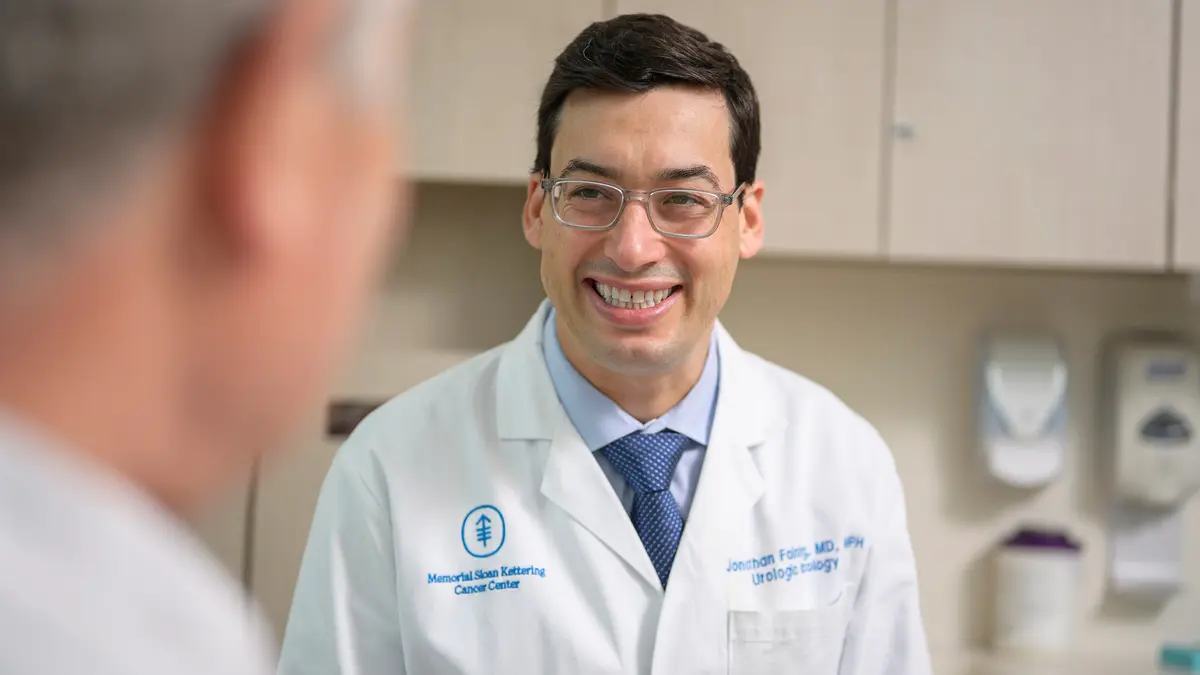
Urologic surgeon Dr. Jonathan S. Fainberg is on a team of MSK experts in prostate cancer diagnosis, surveillance, and treatment.
Overview of prostate cancer focal therapy
Focal therapy works best for small tumors, not for cancer that has spread.
For some people, focal therapy is a good choice instead of radical treatments that target the whole prostate. Such treatments, such as surgery and radiation therapy, can have side effects that include urinary, bowel, and sexual problems.
Focal therapy is less invasive, meaning it does less harm to healthy tissue. It focuses only on the tumor while keeping most of the healthy prostate safe. There can be fewer side effects than radical prostate cancer therapies.
Focal therapy may let people stay on active surveillance longer. Surveillance means monitoring or watching that the cancer does not grow or spread. Low-risk and intermediate-risk prostate cancers often grow and spread very slowly.
Prostate cancer focal therapy is also called prostate cancer partial gland ablation.
Prostate cancer focal therapy is an option for people with intermediate-risk prostate tumors. About 4 or 5 out of every 10 prostate cancers are intermediate risk. The risk is based the tumor’s PSA level, imaging tests, and Gleason score.
Intermediate-risk prostate cancers:
- Can be felt during an exam or seen with imaging.
- Have a Grade Group of 2 or 3. The Gleason score is 7 (3+4 or 4+3).
- Have a PSA level below 20.
How is focal therapy used to treat prostate cancer?
Prostate cancer focal therapy often is done as an outpatient (outside the hospital) procedure. Sometimes people stay overnight in the hospital. The procedure most often takes about 90 minutes to 2 hours.
Real-time images from an MRI or other imaging scans guide the energy source right to the tumor. MSK uses new imaging methods along with other focal therapies. This lets us deliver therapy with great precision.
Prostate cancer focal therapy targets only the tumor and a small margin of normal tissue right around the tumor.
Is prostate cancer focal therapy right for me?
Focal therapy is not for everyone who has prostate cancer. MSK follows strict standards for who should have it. You must first have a complete evaluation.
Focal therapy may not be right for you because:
- You may need more appointments to monitor (watch for) signs the cancer came back.
- You may need surgery or other treatment if the cancer comes back after focal therapy.
- You may not have a type of prostate cancer that focal therapy treats. Focal therapy does not treat high-risk prostate cancer.
MSK experts will confirm your tumor is small and localized (in only 1 part of the prostate). We’ll also make sure we can skip or delay more complex treatment.
MSK experts will treat the part of your prostate gland that has higher-grade cancer. Active surveillance is better for low-grade tumors.
Talk with an MSK Care Advisor. We're here 24 hours a day, 7 days a week.
Types of focal therapy for prostate cancer
The types of prostate cancer focal therapy kill cancer cells in different ways. We choose heat, cold, electricity, or other methods based on the tumor’s size, location, and shape.
There are a few ways to do focal therapy (ablation):
- Freezing: Prostate cancer cryoablation uses a needle to kill cancer cells by freezing them. This treatment is also called cryotherapy.
- Heat: Prostate cancer high-intensity focused ultrasound (HIFU) uses focused ultrasound waves to kill tumor cells with high heat.
- Electric currents: Irreversible electroporation (ee-LEK-troh-por-AY-shun) using a NanoKnife.
MSK is also researching light-based therapy in a clinical trial exploring a new photodynamic therapy (PDT) for prostate cancer.
Most often, you’ll get anesthesia (medicine to make you sleep) before your procedure. Your doctor may place a cystoscope (small, flexible camera) through your urethra to your prostate. They check for anything that can affect your procedure.
Learn more about the types of prostate cancer focal therapy:
Focal cryoablation (KRY-oh-a-BLAY-shun) uses a cryoprobe (a thin needle probe) to freeze the tumor. The probe delivers argon gas right to the prostate tumor, freezing it at a very low temperature. It takes about 20 to 30 minutes to freeze the cancer.
Cryoablation kills the tumor while keeping most of the healthy prostate safe.
Your doctor puts a small ultrasound probe into your rectum. It uses sound waves to show your prostate on a video screen. The images help guide the small needles into your prostate to deliver the treatment.
Cryoablation often takes about 1 to 2 hours.
HIFU kills small prostate tumors with heat. HIFU uses ultrasound waves to heat cancer cells to very high temperatures. Your doctor may use MRI scans to help aim the sound waves at the prostate tumor.
Your doctor puts a small ultrasound probe into your rectum to see and treat your prostate. This probe delivers the ultrasound energy to kill your cancer cells.
HIFU is an outpatient treatment. You’ll have 1 session that takes about 2 hours.
Prostate cancer irreversible electroporation uses a tool called NanoKnife to generate short electrical pulses.
Your doctor puts 4 to 6 electrodes (thin needles) into the prostate around the tumor. We put a small ultrasound probe into the rectum and use MRI scans to guide the electrode placement. This helps us focus the current right around the tumor while keeping nearby healthy tissue safe.
The NanoKnife then passes an electrical current between the electrodes, right through the tumor. The electricity punches very tiny holes in cancer cell membranes. These openings (nanopores) kill the cancer cells.

Follow-up care for focal therapy
After you finish focal therapy for prostate cancer, your care team will monitor you very closely. Your care team includes your surgeon and an advanced practice provider (APP). Your APP is a healthcare provider with special training in prostate cancer and follow-up care.
Both your surgeon and APP work very closely together. We’ll closely monitor your progress after prostate cancer focal therapy. We’ll make a follow-up care plan for you and schedule exams.
You’ll have these lab and imaging tests after prostate cancer focal therapy:
- Prostate-specific antigen (PSA) blood test
- Magnetic resonance imaging (MRI) scans
- Prostate needle biopsy
These tests tell us if you no longer have prostate cancer or if the cancer came back.
After focal therapy for prostate cancer, we’ll also continue to monitor you through active surveillance.
MSK’s prostate surgeons are experts in focal therapy and helped develop methods now used around the world. Our clinical trials study new ways to use focal therapy, reduce pain, and improve recovery. We train surgeons in the United States and other countries to learn these precise methods.
Common questions about prostate cancer focal therapy
Focal therapy can reduce side effects, such as urinary, bowel, and sexual problems. That’s compared with therapies that treat the whole prostate.
Still, focal therapy can cause problems with:
- Urinating (peeing)
- Getting or keeping an erection (getting hard)
You may have fewer side effects than radical (whole prostate) therapy, but more than active surveillance.
Some people get infections in their urinary system or pain in their testicles. It’s common to see blood in your urine after focal therapy.
Side effects often do not last long, from a few weeks to a few months.
It’s not uncommon for cancer to return after focal therapy. That’s why we use active surveillance to monitor (watch) the cancer after treatment.
If the cancer comes back, you often have all options available for treatment. Most people can keep doing active surveillance. Others may need more therapy, such as radical prostatectomy, radiation therapy, or repeat focal therapy.
When cancer returns after focal therapy, it’s often small or medium level. It’s still most often cured with radical (whole prostate) therapies.
MSK has locations in New York City, Westchester, on Long Island, and in New Jersey. Our goal is to bring top experts closer to you.
You’ll have your prostate cancer focal therapy procedure in New York City. Most of your visits before and after the procedure can be at our regional locations or in New York City.
At MSK locations, you can meet with your care team and get more information about focal therapy.