Surgery for Prostate Cancer
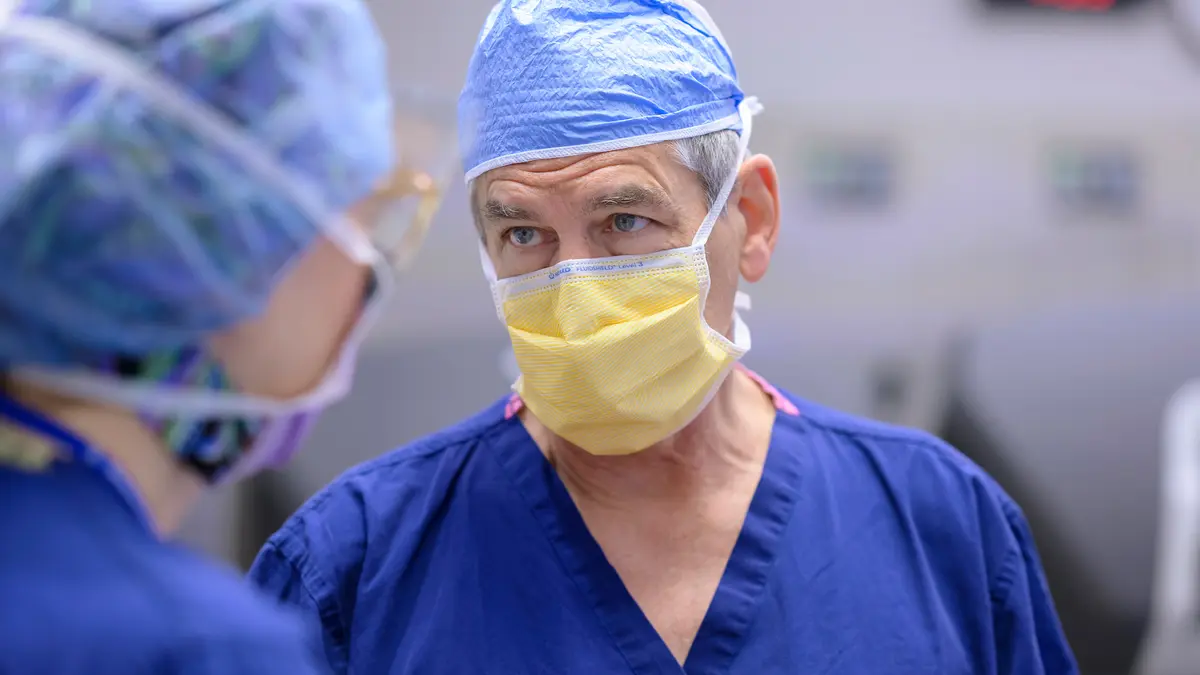
Urologic surgeon Dr. James Eastham, Chief of Urology, is an expert in radical prostatectomy to treat prostate cancer.
Overview of prostate cancer surgery
Surgery is a common treatment for some people with prostate cancer.
Your surgeon will talk with you about which surgery is best for you, based on:
- How far the cancer has spread.
- The cancer’s stage.
- Your family history and genetic risk.
- Your personal preferences.
MSK surgeons may be able to use minimally invasive methods that do less harm to the body. You may recover faster, with fewer prostate cancer side effects. Surgery may sometimes be used along with other therapies.
Many MSK surgeons focus only on prostate cancer. Our prostate surgeons are among the most experienced in the U.S. They’re part of a team ranked #1 in the nation for urology cancer care, 2023 to 2027, by U.S. News & World Report. MSK also ranks among the nation’s top 2 cancer hospitals and is #1 in NY.
Talk with an MSK Care Advisor. We're here 24 hours a day, 7 days a week.
Surgery to remove prostate tumors
Surgery is a common treatment for a tumor that has not yet spread outside the prostate to lymph nodes or bones. Surgery also is recommended for tumors that are likely to grow and spread fast.
A prostatectomy (PROS-tuh-TEK-toh-mee) is surgery to remove part or all of the prostate gland. In general, surgeons remove all of the prostate gland, which is called a radical prostatectomy.
Your surgery will be based on your tumor’s size, location, and other factors. Your MSK care team will assess your lymph nodes to see if the cancer has spread outside your prostate.
If the prostate cancer has spread, your care team will talk with you about other treatments after surgery. Options are radiation therapy or systemic therapy, such as hormone therapy, immunotherapy, or sometimes chemotherapy.
Here are some reasons your care team may recommend prostate removal surgery:
- You just learned you have early-stage prostate cancer that’s higher risk and only in the prostate. You’re likely to have a long life ahead, but MSK’s Active Surveillance Program is not right for you.
- You already had focal therapy, but surgery is recommended because the prostate cancer came back.
- The cancer came back after you had radiation therapy. Surgery after radiation is called a salvage radical prostatectomy.
- The cancer has advanced but can be safely removed with surgery. When this happens, we often recommend surgery along with other treatments to remove all the cancer.
Types of surgery for prostate cancer
Surgery to remove your prostate is called a prostatectomy (PROS-tuh-TEK-toh-mee). This surgery can be done using a few methods. Your surgeon will talk with you about which one is right for you.
There are 2 types of prostatectomies:
- A radical prostatectomy is surgery to remove the prostate gland.
- A salvage radical prostatectomy is prostate removal surgery after radiation treatment.
Radical prostatectomy
A radical prostatectomy is surgery to remove all of the prostate gland and seminal vesicles. These are small tubes that help store semen.
Your surgeon may also remove some of the lymph nodes in your pelvis. This is done to check if cancer cells have spread from your prostate to other parts of your body.
This prostate removal surgery can be done using minimally invasive methods.
MSK experts do more salvage prostatectomies than many hospitals. A salvage radical prostatectomy needs special surgery skills. Research shows surgeons who do more salvage prostatectomies often have fewer surgery complications (problems). That’s compared to surgeons who do this surgery less often.
Salvage radical prostatectomy
A salvage radical prostatectomy can cure prostate cancer for 10 years or more. It treats cancer that’s only in the prostate or nearby tissue.
A salvage radical prostatectomy is prostate removal surgery after radiation therapy. Some people with localized prostate cancer have radiation as their first treatment. Then they need surgery because their PSA levels rise and a biopsy shows cancer cells.
Many people come to MSK for a salvage radical prostatectomy, a surgery not offered at a lot of other hospitals. That’s because scarring from past radiation can make tissue very hard to separate during surgery.
There is a higher risk of side effects after a salvage radical prostatectomy.

Open surgery for prostate cancer
Traditional surgery is often called open surgery. Your surgeon does a single incision (cut) large enough to operate using their tools by hand.
Open surgery often is better to treat cancer that:
- Has spread locally.
- Is high risk.
- Is very hard to remove. This is true for people who had many surgeries in the abdomen (belly).
You’ll be in the hospital for around 2 to 5 days to recover from this type of surgery.
In general, people who have open surgery or minimally invasive surgery have similar long-term results.
Minimally invasive prostate cancer surgery
MSK surgeons are experts in surgery methods that do less harm to your body. Minimally invasive surgery does less harm to your body because it’s done with small incisions (cuts).
Minimally invasive surgery methods are laparoscopy and robot-assisted surgery.
At MSK, we most often use minimally invasive surgery methods for some prostatectomies.
Benefits of minimally invasive surgery for prostate cancer include:
- Less loss of blood.
- A shorter hospital stay.
- A faster recovery.
- Less scarring.
- Less pain.
- Less risk of infection.
- Fewer complications (problems) during and after surgery.
Many people who have minimally invasive prostate removal surgery can go home the next day.
MSK does hundreds of minimally invasive surgeries each year and is one of the busiest cancer centers for these procedures.
- Robotic (robot-assisted) radical prostatectomy
- Laparoscopic radical prostatectomy
- Salvage radical prostatectomy
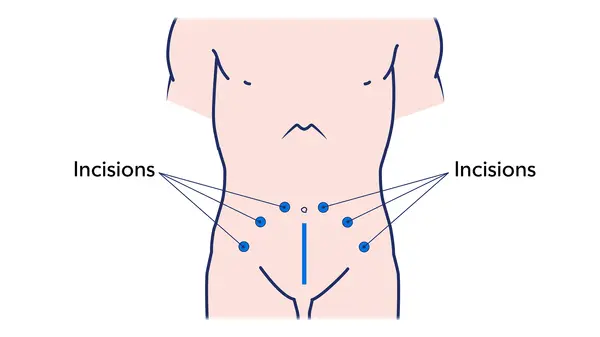
Laparoscopic or robotic-assisted prostatectomy incisions
Laparoscopic (LA-puh-ruh-SKAH-pik) surgery is called a laparoscopy. Your surgeon uses a thin tube with a light and video camera at its tip. This tool is called a laparoscope.
Your surgeon will make a few small incisions (cuts) in the wall of the abdomen (belly). They’ll insert (put) the laparoscope through one of the incisions. This lets your surgeon see the images from the laparoscope on a television monitor.
Your surgeon will put special surgery tools into the other incisions to remove your prostate. Guided by the images on the monitor, your surgeon removes the prostate, seminal vesicles, and lymph nodes.
Robotic surgery is the most common way to do a radical prostatectomy.
Robotic-assisted surgery uses special instruments to remove the prostate and seminal vesicles. Your surgeon may also remove some lymph nodes in your pelvis to check if the cancer has spread.
Your surgeon will sit at a console. There are hand, finger, and foot controls that your surgeon uses to control the operation. The console has a special monitor where they can see very clear, 3D images from inside your abdomen (belly). The console controls the robotic tools used to do the surgery.
MSK’s operating rooms have the latest technology, including 11 robotic platforms. With robotic-assisted surgery, your surgeon uses the da Vinci® Surgical System.
Your caregiver is a very important part of your care team. They need support, too. Our nurse liaisons are here to help your caregiver when you have surgery. They’ll offer updates about your progress during and after surgery. We also have a Caregivers Clinic to help your loved ones cope with cancer.
Side effects of prostate cancer surgery
Your prostate is located near tiny nerves and blood vessels. They control:
- How your bladder works and how you urinate (pee).
- Your sexual function (your ability to get hard enough to have sex).
The prostate is next to the muscle that controls urination (peeing). It’s also next to the tiny nerves that control erections (getting hard). Sometimes prostate removal surgery can affect how you urinate or have erections.
Side effects of prostate cancer surgery include:
- Problems with incontinence (in-KON-tih-nents). This is when urine leaks by accident.
- Erectile dysfunction (eh-REK-tile dis-FUNK-shun), also called ED. This is when you have trouble getting or staying hard.
A salvage radical prostatectomy can also have these side effects:
- Blocked flow of urine.
- Injury to nearby areas, such as the rectum, but this is rare.
MSK has continued care experts to help with prostate surgery side effects. We offer support services, including sexual health and reproductive medicine, physical therapy, and integrative medicine therapies.
MSK’s Wound, Ostomy, and Continence (WOC) care team provides expert care and education. We help manage the most complex wound, ostomy, and continence issues, support recovery after surgery, and improve quality of life. We’re among the few hospitals that offer WOC specialty care at all locations.
Erectile dysfunction, often called ED, means not being able to get or stay hard. This is also called impotence (IM-puh-tents) and is a prostate surgery side effect.
Prostate surgery affects the nerves close to the prostate that control blood flow to the penis. It will take time after your prostate surgery for erections to get back to normal. It can take weeks, or months. But sometimes it may take as long as 3 years after prostate surgery to have full erections again.
In the first few weeks after surgery, you may not be able to get hard enough for sex. This can happen even if you take medicine, such as sildenafil citrate (Viagra). Your care team will talk with you about your options to treat ED.
Prostate removal surgery will make you infertile (in-FER-til). You will not be able to have children with your sperm unless you plan ahead. Before surgery, talk with your care team about sperm banking and other options.
Learn more about our male sexual health services.
Another prostate surgery side effect is urinary incontinence, or when you leak urine (pee). About 9 out of every 10 people who have prostate surgery at MSK can control their urine after a while. You can urinate like you did before surgery within 12 months, and often within just a few months.
But about 5 to 10 out of every 100 people who have prostate removal surgery have a permanent side effect. They have mild stress incontinence that does not go away. Stress incontinence is when you leak a small amount of urine because of pressure on your bladder. It can happen when you exercise, laugh, sneeze, or cough.
MSK treats incontinence with therapy, medicine, or surgery.
After surgery, your pelvic floor muscles that control how you pee are weak. Physical therapy can strengthen these muscles. Read Pelvic Floor Muscle (Kegel) Exercises for Males to learn more.
There also are medicines that lower pressure on your bladder.
Some people may need urinary reconstruction surgery to treat incontinence that does not get better after 1 year of treatment.
Common questions about prostate cancer surgery
Here are some questions about prostate cancer surgery:
- What surgery do you recommend, and why?
- Is surgery better for me than other options? This includes radiation therapy, active surveillance (watching for changes), or focal therapy (partial prostate gland ablation).
- Will I need other treatments before or after surgery?
- When will I know the results of my surgery?
- What are the risks and side effects? Will any of them be long-term?
- Will I be able to go back to normal activities?
- Can I get follow-up care at MSK’s locations in New Jersey, on Long Island, or in Westchester?
Prostate cancer surgery often takes about 2 to 3 hours, but it can take as long as 4 hours. How long a surgery lasts depends on a few things, such as how complex your procedure is.
The number of days you’ll be in the hospital depends on a few things.
They include your general health, and how complex your surgery was. Your hospital stay also depends on whether you have any complications (problems) after surgery.
If you had laparoscopic or robotic-assisted surgery, the average hospital stay is 1 night.
Not everyone feels pain the same way. They also do not have pain or discomfort for the same amount of time. People are walking around the hospital the night after surgery.
You may still have some pain when you go home. Most often, you’ll be taking pain medicine as needed.
The pain often gets much better after the first week. Most people stop taking medicine in 3 to 4 weeks.
Some people can have soreness, tightness, or muscle aches around their incision (cut) for up to 6 months. This does not mean something is wrong. You’ll have less pain and need less pain medicine as your incision heals.
Recovery time is different for everyone. Most people recover from the surgery incision in 3 to 4 weeks or as long as 6 months.
You’ll have a urinary catheter when you go home. Your care team will teach you how to remove the catheter 7 to 14 days after surgery.
You’ll meet with your doctor 2 to 3 weeks after surgery. They’ll give you instructions about which activities you can do, such as exercise, sports, or lifting more than 10 pounds.
